

Could Similar Dna Exist Due To The Chemical Makeup
Homo and Chimp Dna: Is It Really 98% Similar?[i]
One of the slap-up trophies that evolutionists parade to prove man evolution from some common ape ancestor is the assertion that human and chimp Dna are 98 to 99% similar.[ii] People quote this statistic in hundreds of textbooks, blogs, videos, and even scientific journals. All the same whatsoever loftier school student tin debunk the "Human and Chimp Deoxyribonucleic acid is 98% similar" mantra that this affiliate covers.
Why does this matter? We know that genes make up one's mind body features from gender to hair colour. If we are genetically related to chimps, some may conclude that humans should behave like animals, with no fear of divine justice. Just if nosotros all descended from Adam, non from animals, then common animal behavior such equally sexual promiscuity cannot be justified on these grounds.[iii] This has been a master foundation for the mistreatment of humans worldwide by genocidal political leaders and governments over the past 150 or so years. One highly reputable study showed that the leading crusade of death in the 20th century was "Democide"—or "murder by government," which has claimed well over 260 million lives.[4] All of the totalitarian murderous tyrannies the world over, despite their different political variations, maintained the same Darwinian evolutionary philosophy that humans are college animals to be herded and culled in wars, death-camps, abortions, mass starvations, and outright slaughter.[v] Does this event matter? Well, it's a matter of life and expiry. It needs to be refuted if it'due south not truthful.
We should evaluate the major evidences that exposes the 98% myth and supports the current conclusion that the bodily similarity is 84.iv%, or a deviation of 15%, which translates to over 360 million base pairs' departure.[vi] That is an enormous difference that produces an unbridgeable chasm betwixt humans and chimpanzees. The chimp genome is much longer than the human being genome. Humans have forty-6 chromosomes, while chimps have twoscore-8. Co-ordinate to the latest data, there are 3,096,649,726 base pairs in the human genome and 3,309,577,922 base pairs in the chimpanzee genome. This amounts to a vi.4% divergence.[vii] The 98% similarity claim fails on this basis alone.
If man and chimp DNA is nearly identical, why can't humans interbreed with chimps?[viii] Furthermore, such an apparently modest difference in DNA (but one%) does not account for the many obvious major differences between humans and chimps.
If humans and chimps are so similar, then why can't nosotros interchange torso parts with chimps? Over 30,000 organ transplants are made every twelvemonth in the U.S. lone, and currently in that location are over 120,000 candidates on organ transplant lists—but zippo of those transplants will exist made using chimp organs.
Tabular array 1. Organ Transplants[9]
| Organ Transplants (2016) | |||
| Organs | # Currently Waiting | % of Transplants Made Using | |
| Human Organs | Chimp Organs | ||
| All Organs | 121,520 | 100% | 0% |
| Kidney | 100,623 | 100% | 0% |
| Liver | 14,792 | 100% | 0% |
| Pancreas | ane,048 | 100% | 0% |
| Kid./Panc. | 1,953 | 100% | 0% |
| Centre | 4,167 | 100% | 0% |
| Lung | 1,495 | 100% | 0% |
| Heart/Lung | 47 | 100% | 0% |
| Intestine | 280 | 100% | 0% |
A Basic Overview
The living populations of the chimp kind include four species that tin interbreed. From the showtime, they were spirit-less animals created on Twenty-four hours 6 of creation. Subsequently that Day, God fabricated a single man in His own paradigm, and He gave him an everlasting spirit or soul (Genesis two:seven). So God allowable man to "rule over the fish in the sea and the birds in the sky, over the livestock and all the animals," including chimps (Genesis 1:26).
If the cosmos narrative from the Bible is true, we would look exactly what we see in today's ape-kinds. First, all varieties of chimps have no concept of eternity. For instance, they practise non bury their dead nor do they carry funeral rituals. Secondly, apes apply very limited verbal communication—they cannot write articles or even sentences. Thirdly, they practice not display spiritual or religious practices as humans do. In other words, they show no capacity for knowing their creator through worship or prayer. This fits the Biblical creation account that God created humans as spiritual beings with an everlasting spirit or soul (Genesis 2:seven).
It stands to reason that God, in His want to create diverse life forms on Earth, would begin with the same building materials, such equally DNA, carbohydrates, fats, and poly peptide, when making various brute kinds. Research has revealed that He used similar building blocks for all the various concrete life forms that He created. Genetic information in all living creatures is encoded equally a sequence of principally 4 nucleotides (guanine, adenine, thymine, and cytosine, shown past the letters Yard, A, T, and C). We also see this principle in nature—such every bit many plants and animals sharing Fibonacci or similar spirals with articulate algorithms and sequences as building patterns.
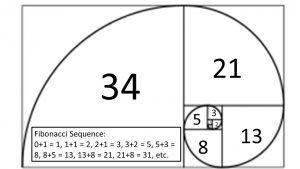
Figure 1. Fibonacci Number Sequence. A Fibonacci spiral approximates the golden spiral using quarter-circle arcs inscribed in squares of integer Fibonacci-number side, shown for square sizes 1, one, two, 3, five, 8, 13, 21, 34 etc.

Figure two. Examples of the Fibonacci Sequence in Nature.[ten]
Chimp and human DNA utilize the same chemicals and share many sequence similarities. However, these likenesses practice not prove that those similarities came from shared ancestors, since similar blueprint can also explain them. Later all, design constraints crave an engineer to use many of the same raw materials and building plans to produce unlike types of biological machines—especially if those machines need to interact with the aforementioned building blocks for growth and life. For example, an automotive engineer could make a Volkswagen bug and a Porsche Carrera framework out of steel, glass, and plastic but not oxygen, carbon dioxide, and sulfuric acid. When experts talk about DNA similarity, they refer to a diversity of different features. Sometimes they talk most humans and chimpanzees having the same genes. At other times, they talk about certain DNA sequences being 98 to 99% similar. Outset, allow'due south consider why human being and chimpanzee DNA sequences are actually closer to 84.four% than 98% like.[xi] And then, describing the concepts of genes and gene similarity will reveal much insight into human and chimp DNA dissimilarity.
Comparisons of Chimps and Humans
One time you empathise that the new DNA testify debunks the declared man evolution paradigm, yous will appreciate that yous are a unique cosmos whom the Creator made in His ain image. You are special and unique compared to all of creation.
A child that sees a chimpanzee can immediately tell that information technology is radically different from a human. Compared to chimps, humans are near 38% taller, are lxxx% heavier, alive 50% longer, and have brains that are near 400% larger (1330 ccs compared to 330 ccs).[xii] Look at someone adjacent to you and roll your eyes at them. Chimps tin can't practise that because their sclera, similar virtually other animals, is hidden behind their eyelids. Now tap your fingertips with your thumb. Chimps tin't do that either—their fingers are curved, their thumbs are both tiny and set further back on their wrists than humans, and they are missing the flexor pollicis longus—the major muscle that controls pollex dexterity in humans. Additionally, their knees point out, whereas ours point forward. Humans can build space shuttles and write songs. Chimps don't do anything close.
Scientists now know that chimpanzees are radically different than humans in many dissimilar ways besides their outward appearance. Humans and chimpanzees have differences in bone structures, in brain types, and in other major parts of their physiology. Humans as well take the ability to express their thoughts abstractly in speech, writing, and music, also every bit develop other complicated systems of expression and communication. This is why humans stand above all other types of creatures.
The claimed small-scale genetic differences betwixt human and chimp Deoxyribonucleic acid (1 to 2%) must account for these and many other major differences! The difference between humans and chimpanzees is major and includes about 350 million different DNA bases. In fact, it is hard to compare the two genomes because of radical differences in system.
Telomeres in Chimps and other apes are almost 23 kilobases (a kilobase is 1,000 base pairs of DNA) long. Humans stand out from primates with much shorter telomeres only 10 kilobases long.[xiii] The human Y chromosome almost completely misaligns with chimpanzees.[xiv] Even if human and chimpanzee Deoxyribonucleic acid sequences are as similar as some evolutionists claim, the Deoxyribonucleic acid coding makes two entirely unlike creatures!
The chromosome fusion theory claims that two smaller chimpanzee chromosomes fused to form human chromosome two. Geneticists have refuted the claim. Sadly, this false claim has been used equally proof of homo evolution, fifty-fifty in textbooks.
Research by Dr. David A. DeWitt has revealed new stunning insights regarding the major differences between human and chimp DNA: There be 40–45 million bases [DNA "letters"] in humans missing from chimps and about the same number present in chimps that are absent from man. These extra Dna nucleotides are termed "insertions" and "deletions" because they are assumed to have been added or lost from the original common ancestor sequence. These differences alone put the total number of DNA differences at nigh 125 million. All the same, since the insertions can be more than one nucleotide long, most forty million total separate mutation events would be required to separate the two species. To put this number into perspective, a typical viii½ x xi-inch page of text has about 4,000 messages and spaces. It would require 10,000 such pages of text equaling 40 million letters or 20 total-sized novels.
The difference between humans and chimpanzees includes about 45 million human being base pairs that chimps don't have and about 45 meg base pairs in the chimp absent from the human.[xv] More enquiry has left no doubt that a specific fix of genetic programming exists for humans and another specific fix exists for chimps. If chimps run on Microsoft, then humans run on Apple software. Both use binary lawmaking, and they have overlapping functions, but each has unique features.
Biology textbooks typically explain that humans descended from some common ancestor related to the keen apes. This animal grouping consists of orangutans, gorillas, and chimpanzees. Of these apes, evolutionists claim that humans are most closely related to chimpanzees based on comparisons of homo DNA to chimp Dna. The real-world consequences of this ideology involve concluding that humans are not special creations, simply that they are evolved animals.
Reality of DNA and Genome Similarity
Let'southward review some basics to go a more accurate motion-picture show of genomes. Human being, plant, and animal Dna is packaged into separate packages chosen chromosomes. Each ane contains millions of the four unlike Dna bases (T, A, C, M), stacked like rungs on a ladder. Their specific society forms a complex set of instructions called the "genetic code." Humans have ii copies of each chromosome: 1 ready of 23 from the mother and one set of 23 from the father. Each chromosome prepare contains over 3 billion base pairs. The information they encode builds whole organisms from unmarried egg cells and maintains each creature throughout its life. Our 46 chromosomes accept a total of six billion DNA bases. Nearly every cell in our body has all of them. When scientists talk near a creature's genome, they refer to one ready of chromosomes. Thus, the reference genome in humans is the sum total of one consummate ready of 23 chromosomes.
The "initial typhoon" of DNA sequences in the homo genome was published in 2001. In 2004, scientists published a more consummate version, only there were nevertheless pocket-size parts that remained to be sequenced, so researchers kept updating the human genome as Deoxyribonucleic acid sequencing technologies improved and more data were acquired. The human genome is now one of the nigh consummate of all known genome sequences–generally because considerably more enquiry money has been spent on it compared to other life forms.
To organize 3 billion bases, researchers utilize unique Deoxyribonucleic acid sequences as reference markers. Then they determine where these brusk sequences are located on each chromosome. They assumed that comparing sequences betwixt related creatures would assist locate them. Scientists initially chose chimpanzees equally the closest creature to humans considering they knew that their proteins and Deoxyribonucleic acid fragments had similar biochemical properties.[xvi] However, some curious researchers chose gorillas and orangutans for comparison. A recent research newspaper fabricated the claim that orangutans' DNAs were more like to humans' Dna in structure and advent than chimpanzee, and thus orangutans should be considered our closest antecedent. Evolutionary scientists disregard this to maintain a consensus that chimpanzees are closest to humans on the hypothetical evolutionary tree. For this reason, most genetics studies presume this relationship before they even begin analyzing DNA.
In the early days of Deoxyribonucleic acid sequencing, in the 1970s, scientists could sequence but very short segments of Dna. For this reason, they focused on DNA segments that they knew would be highly like between animals, such as blood globin proteins and mitochondrial DNA (Dna which is inherited from the mother). They selected like regions for comparing, because you cannot glean any meaningful comparisons between ii Deoxyribonucleic acid sequences that exist but in one and not the other. Researchers discovered that many of the brusque stretches of DNA genetic sequences that code for mutual proteins were not simply highly like in many types of animals, but that they were nearly identical between certain creatures including humans and apes.[xvii]
A basic agreement of what DNA sequencing actually entails helps us understand human and chimp genome accuracy. While the basic Dna sequencing techniques have not inverse much since they were adult, the use of pocket-size-scale robotics and automation now enable researchers to sequence massive amounts of small Dna fragments. The Deoxyribonucleic acid of an entire organism is likewise long to sequence all at once, thus they sequence millions of pieces, each hundreds of bases long. Workers so use computers to digitally assemble the pocket-sized individual pieces into larger fragments based on overlapping sections.[xviii] DNA regions that take hundreds of repeating sequences are, for this reason, very hard to reconstruct, withal we now know that they are important for jail cell part.
Enter New Engineering science
Despite the early, crude indications of apparently high DNA similarity between humans and chimps, precise Deoxyribonucleic acid sequences began to nowadays a very different picture. In 2002, a DNA sequencing lab produced over 3 million bases of chimp Deoxyribonucleic acid sequence in small 50 to 900 base of operations fragments that it obtained randomly across the entire chimp genome.[xix] They then assembled the curt sequences—get this—onto the homo genomic framework.[xx] Talk near circular reasoning. This turned out to be only one of many problems. When the chimp DNA sequences were matched with the man genome by computers, only two-thirds of the DNA sequences could be lined upwards with human being DNA. While many short stretches of Deoxyribonucleic acid existed that were very similar to human Dna, more 30% of the chimp DNA sequence was not fifty-fifty close enough to attempt an alignment.
In 2005, a collaboration of different labs completed the first rough draft of the chimpanzee genome.[xxi] As a rough typhoon, even after the computational associates based on the man genome, information technology still consisted of thousands of pocket-sized chunks of Deoxyribonucleic acid sequences. The researchers then assembled all the small sequences of chimp Dna together to estimate the complete genome. By assuming that humans evolved from a chimp-like ancestor, they used the human genome equally the framework to assemble the chimp Dna sequences.[xxii] At least one lab that helped to assemble the chimp sequence admitted that they inserted chimp Deoxyribonucleic acid sequences into the homo genome layout based on evolution. They assumed that many human-similar sequences were missing from the chimp DNA, and then they added them electronically. That published chimp genome is thus partly based on the man genome. Because it contains human sequences, it appears more man than the chimp genome in fact is. The newest chimp genome, published in 2018, did not use human digital scaffolds and confirms a 15% contrast between humans and chimps. How long volition it take this correction to reach museums and textbooks that demand bad scientific discipline to prop up human evolution?
A large 2013 research project sequenced the genomes of chimpanzees, gorillas, and orangutans to determine their genetic variation. They again assembled all these genomes using the human genome equally a framework![xxiii]
Unfortunately, the research paper describing the 2005 chimp draft genome avoided the trouble of overall average genome similarity with humans by analyzing the regions of the genomes that were already known to be highly similar. This cherry-picking deceptively reinforced the mythical 98% similarity notion. However, enough data were in the 2005 report to allow several independent researchers to calculate overall human-chimp genome similarities. They came upward with estimates of 70 to 80% DNA sequence similarity.[xxiv]
This event is important considering evolutionary theory has a hard enough time explaining how merely 2% of 3 billion bases could take evolved in the three–6 meg years since they believe chimps and humans shared a common antecedent. They want to avert the task of explaining how xv or 20% of iii billion bases evolved in such a brusk time! Natural processes cannot create 369 one thousand thousand letters of precisely coded information in a billion years, let lonely a few million years.[xxv] Instead, every bit shown in the to a higher place section on genetics, more time produces more than mutations, which pb to more than extinctions.
Thus, the ever so popular high levels of human-chimp Deoxyribonucleic acid similarity rely on highly like, selected regions and exclude vastly different regions of these separately created genomes. Cherry-picking of data is bad science. Other published research studies completed between 2002 and 2006 compared certain isolated regions of the chimp genome to human being DNA. These besides seemed to add back up to the evolutionary paradigm, but reinserted unlike Dna sequence data where it could be determined that evolutionists had omitted it from their analyses. This significantly changed the results, which showed that the bodily DNA similarities for the analyzed regions varied between about 66% to 86%.[xxvi] Once more, this showed at least a xiv% difference—non the fake 1%.
One of the main problems with comparing DNA segments betwixt dissimilar organisms that comprise regions of strong dissimilarity is that the computer program commonly used (called BLASTN) stops matching Deoxyribonucleic acid when information technology hits regions that are markedly different. These unmatched sections consequently are not included in the final results, raising significantly the overall similarity between human and chimp DNA. In other words, the human-coded software automatically cerise picks the data. The computer settings can be changed to turn down DNA sequences that are not similar enough for the research needs. The mutual default setting used by most evolutionary researchers kicks out anything less than 95% to 98% in similarity. In 2011, Dr. Tompkins compared 40,000 chimp Dna sequences (subsequently removing them from the human being-genome scaffold bias) that were nigh 740 bases long and already known to be highly like to human.[xxvii] The longest matches showed a DNA similarity of only 86%. A secular study independently establish the aforementioned level of dissimilarity, again nailing the coffin on top of the false 98% claims.[xxviii]
If chimp Dna is so dissimilar to human, and the figurer software stops matching after only a few hundred bases, how can nosotros find the actual similarity of the human and chimp genomes? A 2013 study resolved this problem by digitally slicing upwards chimp DNA into the small fragments that the software'due south algorithm could optimally match.[xxix] Using a powerful computer dedicated to this massive computation, all 24 chimp chromosomes were compared to humans' 23 chromosomes. The results showed that, depending on the chromosome, the chimp chromosomes were betwixt 43% and 78% similar to humans. Overall, the chimp genome was merely about lxx%[xxx] like to man. These information confirmed results published in secular evolutionary journals, simply not popularized past the media or evolutionists.
Although textbooks still contain the 98% Deoxyribonucleic acid similarity claim, many scientists in the human-chimp research community now recognize the 96% to 98% similarity was derived from isolated areas and biased assemblies. However, while the 98% similarity is crumbling, geneticists rarely make public statements about overall estimates because they know it would debunk human evolution. Although the human and chimpanzee genomes overall are simply about 84.4% similar, some regions have high similarity, mostly due to poly peptide-coding genes. Even these high similarity areas actually have merely about 86% of matching sequences overall when the algorithm used to analyze them is set to produce a very long sequence match.[xxxi]
The regions of high similarity can be explained by the fact that mutual genetic code elements are often found between different organisms because they code for genes that produce proteins with like functions. For the same reason that different kinds of craftworkers all utilise hammers to drive or pry nails, unlike kinds of creatures use many of the same biochemical tools to perform common cellular functions. The genome is a very circuitous system of genetic codes, many of which are repeated in organisms with like functions. This concept is easier to explain to estimator programmers and engineers than biologists who are steeped in the evolutionary worldview.
Gene Similarities—the Big Picture show
If two different kinds of creatures take the aforementioned basic gene sequence, they normally share only a certain part of that sequence. The entire gene could be only 88% similar, while a small role of it may be 98% similar. Protein-coding gene regions chosen "exons" in humans are on boilerplate just almost 86% to 87% similar to chimps. Often, a matching chimp gene completely misses the exon sequences inside the human version of that factor.
The original definition of a cistron describes it as a DNA section that produces a messenger RNA which in turn codes for a poly peptide. Early estimates projected that humans independent well-nigh 22,000 of these protein-coding genes, and the almost contempo estimates suggest 28,000 to xxx,000.[xxxii] We now know that each of these protein-coding genes can produce many different individual messenger RNA variants due to gene regulation strategies. Cellular machinery cuts and splices gene sections to generate sometimes dozens of useful products from just 1 of those 28,000 or so traditional genes. Consequently, over a million RNA varieties tin be fabricated from 30,000 or fewer genes! Nevertheless, less than 5% of the human genome contains actual "exon" protein-coding sequences.
Humans take a high level of Dna/factor similarity with creatures other than chimps
The man body has many molecular similarities with other living things. After all, they all use the same basic molecules. They share the same water, oxygen, and nutrient sources. Their metabolism and therefore their genetic makeup resemble one another in social club to occupy the same world. All the same, these similarities do not mean they evolved from a mutual antecedent any more than all buildings constructed using brick, iron, cement, glass, etc. ways that they share origins.
Dna contains much of the information necessary for an organism to develop. If two organisms look similar, we would expect DNA similarity betwixt them. The DNA of a cow and a whale should be more alike than the DNA of a cow and a bacterium. Too, humans and apes take many body similarities like bones, hair, and the ability to produce milk, so we would look Dna sequences to friction match that. Of all known animals, the bully apes are almost similar humans, so we would wait that their Dna would exist most like human DNA.[xxxiii]
This is non always the example, though. Some comparisons between human Deoxyribonucleic acid/genes and other animals in the literature including cats have 90% of homologous genes with humans, dogs 82%, cows 80%,[xxxiv] chimpanzees 79%, rats 69%, and mice 67%.[xxxv] Other comparisons found include fruit wing (Drosophila) with about 60%[xxxvi] and chickens with about 60% of genes corresponding to a similar human being gene.[xxxvii] These estimates suffer from the same problems that humans-chimp comparisons do, but they illustrate the patterns of similarity that 1 would wait from a single divine designer.
The Myth of "Junk" DNA
The xxx,000 or so genes of the human genome occupy less than v% of the 3 billion total base pairs in the human genome. When researchers offset fabricated this approximate in the early on 1990's, nobody knew what the other 95% of the genome did. Considering evolution theorists needed raw genetic material for nature to tinker with over millions of years, they decided that it had no part. They labeled it "junk DNA." Oh, how wrong they were. After junk Deoxyribonucleic acid became entrenched in textbooks, scientists began testing the 95% to see if cells utilise it for something other than protein codes. Beginning at around 2005, inquiry from different labs all over the world has documented that cells transcribe and employ over xc% of the entire human genome. The DNA codes for a dizzying array of RNA molecules. Information technology performs many of import jobs in the cell.[xxxviii] This phenomenon, called "pervasive transcription," was discovered in an offshoot of the man genome project called ENCODE, which stands for ENCyclopedia of Dna Elements.[xxxix]
They discovered that most DNAs regulate the timing and amount of proteins produced. Imagine that the smart phone industry has no clue how many consumers desire to purchase smart phones. It could plow the world'south petroleum into phones, leaving none to make nuance board, refrigerators, or medicines. Chaos would reign. Or it could make just 10 phones a year. That would derail commerce worldwide. Chaos either way. Regulating the number, charge per unit, and placement of bricks is fifty-fifty more important than just having bricks. In a similar way, every cell must regulate its proteins to avoid chaos. No wonder junk DNA advocates grow quiet.
While refuting "junk" DNA, the ENCODE projection has also redefined our concept of a factor. At the fourth dimension of this writing, experts estimate that non-protein-coding RNA genes chosen long noncoding RNAs or "lncRNAs" outnumber protein coding genes at least 2 to 1.[xl] They have similar DNA structures and control features as poly peptide-coding genes, just instead they produce useful RNA molecules.
Some RNAs remain in the jail cell nucleus with the DNA to regulate newborn RNA sequences. Other RNAs exit the nucleus to assistance regulate with the quality and speed of production, or the final shape and placement of other RNAs or proteins. The cell exports special RNAs called lncRNAs outside of the prison cell. It stands for "Long, Non-Coding RNA's." Whoever named them didn't bother to actually check whether or not they coded for any useful product. Afterward enquiry found that lncRNAs communicate with other cells. Simply now we are stuck with the development-friendly name. Many of these lncRNA genes play important roles in a process called epigenetics. This records data on top of DNA, telling upwards to around half dozen generations to keep certain gene regions airtight.
Many evolutionary studies compared only highly similar poly peptide-coding regions, the lncRNA regions are merely about 67 to 76% similar—about ten to 20% less identical than the poly peptide-coding regions. Chimp and human being lncRNAs are very dissimilar from each other, but they are critical to each life form.
Possibly the entire genome is a storehouse of important data. Using the construction projection analogy, the poly peptide-coding genes are similar building blocks, and the noncoding regions regulate and determine how and where the building blocks get used. This is why the protein-coding regions tend to show more similarities betwixt organisms and the noncoding regions show fewer similarities. Poly peptide-coding regions specify skin, hair, hearts, and brains, merely "noncoding" regions actually do code information that helps organize these components into useful arrangements. Given their millions of DNA differences, no wonder humans and chimps expect and act so different!
Chromosome Fusion Debunked
Ane key argument that evolutionists utilise to support the human-chimp story is the supposed fusion of ii ape-like chromosomes to form human chromosome number two. The swell apes actually comprise ii more (diploid) chromosomes than humans. Humans take 46 and apes have 48. Portions of two modest ape chromosomes look somewhat similar to human chromosome 2 when observed under a microscope after special staining. Evolutionists argue that they expect so like because they descended from 1 ancestral population with 2 chromosomes. At some point, those ii supposedly joined into ane chromosome and evolved into humans while some other segment kept the two chromosome and evolved into chimps.[xli] How do they know this happened? Does evidence inside human chromosomes neglect to fit this story?
Taking their cues from evolutionary assumptions, secular researchers called these two chimp chromosomes 2A and 2B. Gorillas and orangutans also have chromosomes numbered 2A and 2B.
In 1991, scientists institute a brusk segment of DNA on human chromosome two that they claimed was evidence for fusion. Information technology looked to them similar a genetic scar left over from ii chromosome ends that were supposedly stitched together, even though information technology was not what they should have expected based on the assay of known fusions in living mammals.[xlii] The declared fusion sequence consisted of what looked like a degraded caput-to-head fusion of chromosome ends called "telomeres." Could the similarities between these 2 ape chromosomes and man chromosome two come from some cause other than common ancestry? What detailed features would we expect to see if these chromosomes fused to get one in humans?
Telomeres contain repeats of the Dna sequence TTAGGG over and over. Geneticists beginning found them on the ends of each chromosome, similar protective caps. T represents the chemical Tyrosine; A, Adenine; and G, Guanine. The organization of these chemicals encodes information, only like messages of the alphabet. Telomeres on human being chromosomes are typically v,000 to xv,000 bases long. If these fused, and so they should have x,000 to 30,000 TTAGGG repeats at the fusion site, plus or minus some from many generations of mutations.[xliii] The alleged fusion site, however, has only well-nigh 800 bases. Plus, these bases look only 70% like to the expected. Plus, telomeres are specifically designed to prevent chromosomal fusion, and this is why a telomere-telomere fusion never has been observed in nature!
This fusion idea has for many years been masquerading as proof of human evolution, but genetic inquiry has completely refuted the story. Not only is the site some orders of magnitude smaller than expected, only it has functional DNA. Cells access the "site" daily for its of import RNA factor.[xliv] In 2002, researchers sequenced over 614,000 DNA bases surrounding the supposed fusion site and found that it was in a factor-rich region. The fusion site lies within what they originally labeled a pseudogene. These describe supposedly damaged remnants of formerly useful poly peptide-coding genes.[xlv] They supposedly correspond more genetic junk from a messy evolutionary past. However, continual discoveries of important cellular roles for "pseudogenes" go on surprising evolutionists, who expect junk simply proceed finding functional genetic design. Why exercise higher biochemistry and high schoolhouse biology textbooks neglect to explain these new results or to admit that science has refuted the chromosome fusion model?
Even more clear prove for creation is the finding that not one of the other genes within 614,000 bases surrounding the alleged fusion site exists in chimpanzees. Although many evolutionists, perhaps unaware of the recent inquiry, nevertheless promote it, the facts neglect to fit fusion. They instead reveal how sensible is the idea that God created human chromosome 2.
Beta-globin Pseudogene Debunked
Another story that evolutionists use to promote human-ape ancestry holds that humans and chimps shared the same genetic mistakes. This supposedly explains why both of them have the same supposedly broken genes, called pseudogenes. Their story sounds sensible at start. Our common ancestor had a gene that mutated. Subsequently its descendants diverged, the chimp and human family trees both retained those former mutations. After all, they debate, how else could two unlike but similar species have the same mutations in the same genes unless they evolved from the same ancestor?
If this story was true, then we were obviously not created in God's image. Fortunately, exciting new research shows why science supports Scripture's documentation of creation. As noted, cells actually use many so-chosen "pseudogenes." They produce important noncoding RNAs discussed previously.[xlvi] This ways that the shared Deoxyribonucleic acid sequence "mistakes" were purposefully created DNA sequences all forth. They merely perform the aforementioned task in the two unlike organisms. Thus, common function, not common beginnings, gives the reason for their similar (and quite useful) sequence.
The beta-globin pseudogene exemplifies this. Information technology turns out, of course, that this gene serves a helpful office in cells. As well bad evolutionists failed to look for function earlier they declared it had no function. The beta-globin sequence fits right in the middle of a cluster of five other genes. The other 5 genes help produce useful proteins. Evolutionists originally claimed that the beta-globin gene was broken because it did not produce a poly peptide. Now multiple studies have shown that it produces lncRNAs (see higher up) and is the well-nigh genetically networked gene in the entire beta-globin cistron cluster. This ways the cell accesses it more ofttimes than the others.[xlvii] The supposed pseudo (or "false") gene regulates the product rates of the other genes. Over 250 dissimilar types of human cells actively use the gene! Why do chimps and humans share this very similar sequence? Not because they both inherited information technology from a mutual ancestor, but because they both employ it for very like purposes, similar lungs for breathing.
GULO Pseudogene Debunked
Another case of textbook prove for human being development is the GULO pseudogene. This actually looks similar a broken gene. Information technology looks like the real GULO gene, which codes for an enzyme to assistance brand vitamin C, but it has differences. It seems similar mutations have garbled its once-useful lawmaking. Evolutionists merits that humans, chimps, and other apes share GULO genes that mutated in the same places because the mutations occurred in an antecedent that all three supposedly share. However, cleaved GULO pseudogenes are as well found in mice, rats, bats, birds, pigs, and famously, guinea pigs. Did we evolve from guinea pigs?
When researchers recently analyzed the GULO gene in its entirety, they found no pattern of common ancestry.[xlviii] Instead, information technology looks like this gene is predisposed to existence mutated no matter what fauna has it. Since humans and other animals can get vitamin C from their nutrition, they can survive without the gene. Also, the other genes in the GULO biochemical pathway produce proteins that assistance other important cellular processes. Losing those could spell disaster for the organism. So, many creatures and humans can tolerate a damaged GULO gene by consuming enough of vegetables with vitamin C.
The GULO gene region and the mutations that likely damaged it link to a system that utilise transposable elements. These are commonly called "jumping genes," and they tin can cut themselves out of one location in the genome and splice themselves into another location. The many dissimilar types of transposable elements in the human genome serve very important tasks. Sometimes, though, they splice themselves into the incorrect location and disrupt genes.
In the case of GULO, the transposable element patterns between humans and each of the ape kinds that were evaluated show differences. Therefore, GULO shows no pattern of common ancestry for humans and apes—negating this evolutionary argument. Like the claims of 99% similarity, chromosome fusion, and Beta-globin, evolutionists built the GULO argument based on belief in evolution plus an ignorance of biology.
In reality, the GULO pseudogene data defy evolution and vindicate creation. According to the Genesis business relationship of the fall that caused the curse on creation, we would expect genes to mutate. This ane did. No known animal avoids this process of genetic decay, called genetic entropy (see to a higher place department on genetics). Cornell University Geneticist John Sanford has shown in several studies that the man genome shows no signs of evolving or getting better. Instead it irreversibly crumbles.[xlix] Mayhap our early on ancestors had a working GULO gene that could manufacture vitamin C. Today, low vitamin C in our diets causes an illness called scurvy.
The Homo-Chimp Evolution Magic Deed
Phase magicians, otherwise known every bit illusionists, practice their trade by getting y'all to focus on some attribute of the magician'south act to divert your focus from what the other hand is doing. This way, they get you lot to believe something that isn't true—a imitation reality. The human-chimp Deoxyribonucleic acid similarity "inquiry" works almost the same style.
The evolutionist who promotes the human-chimp false paradigm of DNA similarity accomplishes the magic human activity by getting you to focus on a small prepare of information representing $.25 and pieces of manus-picked evidence. In this way, yous don't come across the mountains of difficult data that utterly defy evolution. While some parts of the human being and chimpanzee genomes are very similar—those that the evolutionists focus on—the genomes overall are vastly different, and the difficult scientific evidence at present proves it. The magic act isn't working whatever longer, and more and more open up-minded scientists are starting time to realize information technology.
Confronting Human-Chimp Propaganda
To close this department, allow's talk over a hypothetical exchange. How tin you lot use the information in this department in conversation? Offset, the person makes the claim that "human and chimp Dna are genetically 98–99% identical or like." When such a person does not wish to listen, starting with a question, not a counter, virtually always helps. If yous have memorized the genome lengths, y'all tin ask, "Exercise you lot know roughly how many bases are in the chimp and human genomes?" If they exercise, great. If not, and then offer the fact that the chimp genome has 3.3 billion, and the human genome iii.1 billion bases. Then enquire, "Do you call back the per centum divergence between these numbers is 1, two, or more?" You can and so calculate it together. Use ((three.1/3.three) – i) X 100. Ignore the negative sign (take the absolute value). When you both meet that it equals about a half-dozen% departure, and so just ask, "How tin can the two be simply 1% dissimilar if their full lengths are already half dozen% unlike?"
At this point in the conversation, yous will speedily find out if the person is really interested in learning more about the outcome of man origins, or if they are so zealous near evolutionary behavior that they refuse to listen to challenging evidence. If at that signal they begin making up an answer, balance assured that they have no want to learn annihilation from yous. If, on the other hand, their conviction in the ane% assertion fades, then you may have just earned the correct to offer more data.
When the other person shows involvement in what you might have to say, yous could mention, "The 99% similarity only applies to the highly like regions. It ignores the many differences in the already dissimilar regions." You can and so analyze this response by noting that "2018 research has shown that, overall, the entire genome is no more than than 85% similar on average when yous include all the Deoxyribonucleic acid that researchers decoupled from the human genome in 2018. This equal to 15 percent difference demands hundreds of millions of precise base pair changes in just 3–6 one thousand thousand years. Can you help me explain how mutations could attain that?"
You can also add, "Several thousand genes unique to humans are completely missing in chimps, and scientists have found many genes that are unique to chimps are missing in humans." Then inquire, "How tin can evolutionary processes explicate these massive differences?" Take care to ask open up-ended and genuine questions. Avoid using "you." Nosotros don't want to accuse anybody, just atomic number 82 them to convince themselves that their own ideas have bug. Another useful question asks, "How could only 1–2% Dna deviation account for such major trunk differences betwixt humans and chimps, similar thousands of new genes, unlike hand, muscle and encephalon architecture, and the 40 facial muscles that humans use to communicate, compared with the dozen or then in chimp faces?"
In reality, the whole modern research field of genetics and genomics is the worst enemy of evolution. As new genomes of different kinds of organisms are beingness sequenced, they consistently testify unique sets of DNA containing many genes and other sequences that specify that type of animal. Evolutionists telephone call these new creature-specific genes "orphan genes" because they are not found in any other type of known creature.[l] Orphan genes appear suddenly in the pattern of life as unique sections of genetic code with no hint of evolutionary history. Of class, believers in an omnipotent Creator know that each different genome, such every bit that for humans and that of chimpanzees, was separately, uniquely, and masterfully engineered at the beginning of creation. God created and embedded each creature'southward orphan genes to network with all the balance of that creature's genetic coding instructions. The scientific information overwhelmingly testify that God deserves the credit and evolution deserves none.
Conclusion
With so much at stake, similar the respond to life's largest question, "Where did I come from?" do we want to trust in extremely biased answers? Every high schoolhouse student can abnegate 98% similarity dogma by tracking the main points above as outlined below.
Point 1 – Overall, the unabridged genome is simply about 84.4% like on average when you lot include all the Deoxyribonucleic acid. This is equal to a xv% difference, or 360 million+ base pair differences. (Slight differences exist between using the 2004 assembly, which made the data look more human than the unbiased 2018 associates). Either associates reveals a genetic chasm between our supposed closest evolutionary relative.
Point 2 – The "Junk" DNA claim has long been refuted and nearly of it has been found to take clear functions which are regulatory in nature.
Point 3 – The Chromosome Fusion claim is false for four reasons. First, telomeres are designed not to fuse. Telomere to telomere fusion is unknown in the natural world. This makes the evolutionary exclamation hard for them to defend. Second, telomeres comprise repeats of the DNA sequence TTAGGG over and over for thousands of bases. Man telomeres are from 5,000 to fifteen,000 bases long. If these really fused, then they should have over x thousand TTAGGG bases, but the alleged fusion site actually has about 800 bases. Third, the "fusion site" sequence shares only seventy% similarity to what expectations would dictate. Concluding, the claimed fusion site contains a gene, proof that information technology is not a genetic scar at all.
Point 4 – The Beta-globin Pseudogene is non a pseudogene! Without this status, its employ to contend for homo-chimp common ancestry crumbles. It is actually a functional gene in the middle of a cluster of five other genes.
Point 5 – The GULO Pseudogene does not prove mutual decent, but simply shows an area of both genomes that is prone to mutate.
[i] Thanks to Jeffrey Tomkins, Ph.D., Jerry Bergman Ph.D., and Brian Thomas, Grand.S. for this section.
[ii] Jonathan Silvertown (ed), 99% Ape: How Evolution Adds Up (University of Chicago Press, 2009): iv.
[iii] Bruce Bagemihl, Biological Exuberance: Animal Homosexuality and Natural Diversity (1999). St. Martins Press. New York.
[iv] R.J. Rummel, "Statistics of Democide: Genocide and Mass Murder Since 1900," School of Police, University of Virginia (1997).
[five] Jerry Bergman, Hitler and the Nazis Darwinian Worldview: How the Nazis Eugenic Crusade for a Superior Race Acquired the Greatest Holocaust in World History, (Kitchener, Ontario, Canada: Joshua Printing, 2012).
[vi] J. Tomkins, "Separate Studies Converge on Human being-Chimp DNA Contrast." Acts & Facts 47 (11) (2018): nine.
[vii] Run across: http://useast.ensembl.org/Homo_sapiens/Info/Annotation
[viii] Many attempts have been made and all accept failed. See Kirill Rossiianov, "Across Species: 2'ya Ivanov and His Experiments on Cantankerous-Breeding Humans with Anthropoid Apes." Scientific discipline in Context. xv (2) (2002): 277–316.
[nine] Meet the U.S. Department of Health and Man Services (https://optn.transplant.hrsa.gov/) (February i, 2016).
[x] Credit: Wikipedia
[eleven] Tomkins, 2018.
[xii] Various sources will show pocket-sized differences in these comparisons. These are for example merely.
[thirteen] S. Kakuo, K. Asaoka, and T. Ide, "Human is a unique species among primates in terms of telomere length." Biochemistry Biophysics Enquiry Communication, 263 (1999): 308–314
[14] N. Archidiacono, C.T. Storlazzi, C. Spalluto, A.S. Ricco, R. Marzella, M. Rocchi, "Evolution of chromosome Y in primates." Chromosoma 107 (1998): 241–246.
[xv] Answers in Genesis: "What about the Similarity Between Human and Chimp Deoxyribonucleic acid?" www.answersingenesis.org/articles/nab3/human-and-chimp-dna (January 14, 2014).
[xvi] J. Bergman & J. Tomkins, "Is the Human Genome Almost Identical to Chimpanzee? A Reassessment of the Literature" Periodical of Cosmos 26 (2012): 54–60.
[xvii] Ibid.
[eighteen] J. Tomkins, "How Genomes are Sequenced and why information technology Matters: Implications for Studies in Comparative Genomics of Humans and Chimpanzees," Answers Research Journal iv (2011): 81–88.
[xix] I. Ebersberger, D. Metzler, C. Schwarz, & S. Pääbo, "Genomewide Comparison of Dna Sequences between Humans and Chimpanzees," American Journal of Human being Genetics 70 (2002): 1490–1497.
[20] "Human-Chimp Genetic Similarity: Is the Evolutionary Dogma Valid?" Establish for Creation Research: www.icr.org/commodity/6197/
[xxi] Chimpanzee Sequencing and Analysis Consortium, "Initial Sequence of the Chimpanzee Genome and Comparing with the Man Genome," Nature 437 (2005): 69–87.
[xxii] J. Tomkins, "Genome-Broad Dna Alignment Similarity (Identity) for 40,000 Chimpanzee Dna Sequences Queried against the Human Genome is 86–89%," Answers Inquiry Journal four (2011): 233–241.
[xxiii] J. Prado-Martinez, et al. "Cracking Ape Genetic Diversity and Population History," Nature 499 (2013): 471–475.
[xxiv] J. Tomkins, & J. Bergman. "Genomic Monkey Business organization—Estimates of Nearly Identical Homo-Chimp DNA Similarity Re-evaluated using Omitted Information," Journal of Creation 26 (2012), 94–100; J. Tomkins, "Comprehensive Analysis of Chimpanzee and Human being Chromosomes Reveals Boilerplate DNA Similarity of 70%," Answers Research Periodical 6 (2013): 63–69.
[xxv] Nathaniel T. Jeanson, "Purpose, Progress, and Promise, Function 4," Institute for Creation Enquiry: http://world wide web.icr.org/article/purpose-progress-promise-part-4 (September 2, 2015).
[xxvi] Tomkins & Bergman, 63–69.
[xxvii] Tomkins, 2011.
[xxviii] R. Buggs, "How similar are human and chimpanzee genomes?" Posted on Richardbuggs.com July xiv, 2018, accessed August 9, 2018.
[xxix] Tomkins & Bergman, 63–69.
[xxx] Subsequent analyses revealed an anomaly in the BLASTN algorithm used for determining the seventy% effigy and the revised estimate (88%) has been included in this affiliate. See: Jeffrey P. Tomkins, "Documented Anomaly in Recent Versions of the BLASTN Algorithm and a Complete Reanalysis of Chimpanzee and Homo Genome-Wide Deoxyribonucleic acid Similarity Using Nucmer and LASTZ," (October 7, 2015), Answers in Genesis: https://answersingenesis.org/genetics/dna-similarities/blastn-algorithm-anomaly/
[xxxi] Tomkins, 2011.
[xxxii] East. Wijaya, M.C. Frith, P. Horton & K. Asai, "Finding Protein-coding Genes through Human Polymorphisms," PloS 1 eight (2013).
[xxxiii] New Genome Comparison Finds Chimps, Humans Very Similar at the DNA Level, 2005, National Human Genome Enquiry Institute (www.genome.gov/15515096 )
[xxxiv] Christine Elsik. et al. The Genome Sequence of Taurine Cattle: A Window to Ruminant Biological science and Evolution. Scientific discipline. 324:522-528.
[xxxv] Source is Pontius, Joan. et al., 2007. Initial Sequence and Comparative Analysis of the Cat Genome. Genome Research. 17:1675–1689 (www.eupedia.com/forum/threads/25335-Percent-of-genetic-similarity-between-humans-and-animals).
[xxxvi] Groundwork on Comparative Genomic Analysis (December, 2002) (www.genome.gov/10005835).
[xxxvii] NIH/National Human Genome Inquiry Institute. "Researchers Compare Chicken, Human Genomes: Analysis of Commencement Avian Genome Uncovers Differences Between Birds and Mammals." ScienceDaily (December 10, 2004).
[xxxviii] One thousand. J. Hangauer, I.W. Vaughn & M. T. McManus, "Pervasive Transcription of the Human being Genome Produces Thousands of Previously Unidentified Long Intergenic Noncoding RNAs," PLoS genetics nine (2013).
[xxxix] S. Djebali, et al. "Landscape of Transcription in Human Cells," Nature 489 (2012): 101–108.
[xl] Thou. D. Paraskevopoulou, et al. "DIANA-LncBase: Experimentally Verified and Computationally Predicted MicroRNA Targets on Long Non-coding RNAs," Nucleic Acids Research 41 (2013): 239–245.
[xli] J. J Yunis & O. Prakash, "The Origin of Man: A Chromosomal Pictorial Legacy," Scientific discipline 215 (1982): 1525–1530.
[xlii] J. Westward. Ijdo, A. Baldini, D.C. Ward, S. T. Reeders & R. A. Wells, "Origin of Human Chromosome 2: An Ancestral Telomere-telomere Fusion," Proceedings of the National Academy of Sciences of the U.s. 88 (1991): 9051–9055.
[xliii] J. Bergman & J. Tomkins, "The Chromosome 2 Fusion Model of Human being Evolution—Role 1: Re-evaluating the Evidence," Journal of Creation 25 (2011): 110–114.
[xliv] J. Tomkins, "Alleged Homo Chromosome 2 'Fusion Site' Encodes an Active DNA Binding Domain Within a Circuitous and Highly Expressed Gene—Negating Fusion," Answers Inquiry Journal 6 (2013): 367–375.
[xlv] Y. Fan, Due east. Linardopoulou, C. Friedman, E. Williams & B.J. Trask, "Genomic Structure and Evolution of the Ancestral Chromosome Fusion Site in 2q13-2q14.1 and Paralogous Regions on other Human Chromosomes," Genome Research 12 (2002): 1651–1662; Y. Fan, T. Newman, Eastward. Linardopoulou, & B.J. Trask, "Factor Content and Function of the Bequeathed Chromosome Fusion Site in Human Chromosome 2q13-2q14.1 and Paralogous Regions," Genome Inquiry 12 (2002): 1663–1672.
[xlvi] Y.Z. Wen, L. L. Zheng, L.H. Qu, F. J. Ayala & Z.R. Lun, Z. R, "Pseudogenes are non Pseudo Any More," RNA Biology 9 (2012): 27–32.
[xlvii] J. Tomkins, "The Man Beta-Globin Pseudogene Is Non-Variable and Functional," Answers Research Journal 6 (2013): 293–301.
[xlviii] M. Y. Lachapelle, & G. Drouin, "Inactivation Dates of the Human and Guinea Pig Vitamin C Genes," Genetica 139 (2011): 199–207.
[xlix] J. Sanford, Genetic Entropy and the Mystery of the Genome, 3rd ed (FMS Publications, 2010).
[l] J. Tomkins & J. Bergman, "Incomplete Lineage Sorting and Other 'Rogue' Data Fell the Tree of Life," Journal of Creation 27 (2013): 63–71.
Source: https://genesisapologetics.com/faqs/human-and-chimp-dna-is-it-really-98-similar/
Posted by: stevensbrombon.blogspot.com
0 Response to "Could Similar Dna Exist Due To The Chemical Makeup"
Post a Comment